
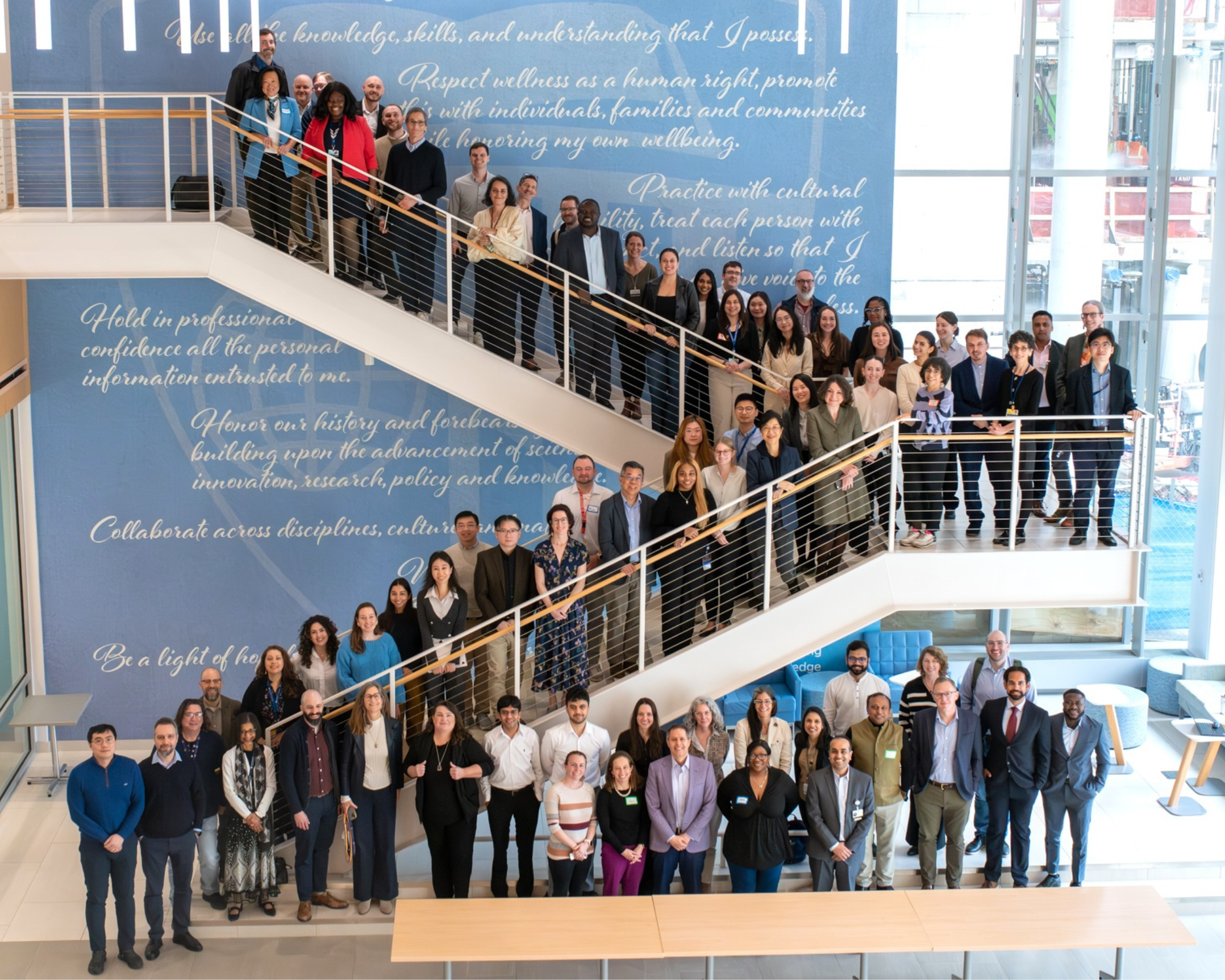
Ninety-four researchers, clinicians, students, and staff from across the Johns Hopkins health ecosystem gathered on March 13 at the School of Nursing for the Hopkins Business of Health Initiative's Spring '26 Retreat, the initiative's largest retreat to date.

Faculty represented five university divisions: the Bloomberg School of Public Health, the Carey Business School, the School of Medicine, the School of Nursing, and the Whiting School of Engineering. The daylong program moved from completed research to community-building to innovation, following the cycle that defines HBHI's approach to cross-disciplinary collaboration.

"We want you all to connect in new ways and pursue a better health care system," HBHI Director Dan Polsky, PhD, said in his opening remarks, noting that the retreats have grown from hybrid gatherings of 40 to 50 during the pandemic to close to 100 attendees this spring.
Pilot grant findings

Three 2025 HBHI pilot grant recipients presented their findings, moderated by Michael Darden, PhD, of the Carey Business School.
Leila J. Mady, MD, PhD, MPH, presented research linking cancer drug utilization patterns to financial toxicity, using the Truveta electronic health record platform to track the rapid adoption of immune checkpoint inhibitors across cancer types and regions. Kaimy Torres-Hernandez shared findings on language access in health care, revealing that interpreter training at Hopkins is not differentiated by clinical specialty, meaning a mental health encounter and an emergency department visit receive the same level of interpreter preparation. Nicholas Tilipman, PhD, showed that insurance brokers steer employers toward costlier health plans, but that capping commissions shrinks broker networks and softens competition, a tradeoff that complicates regulatory approaches.


Lightning talks
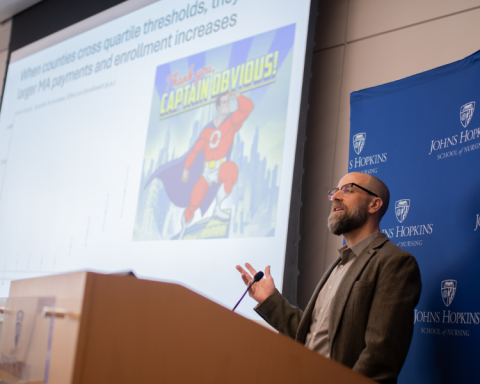
Six lightning talks showcased the breadth of the HBHI research community. Hae-Ra Han, PhD, RN, FAAN, of the School of Nursing, presented Project PLAN. This multi-site clinical trial trained community health workers to screen more than 2,700 immigrant older adults for dementia and connect them to medical evaluation. Alicia Arbaje, MD, MPH, PhD, of the School of Medicine, described hospital-to-home care transition failures that she found occur in virtually every discharge, and presented a new quality index designed to identify them in real time. Weiguang Wang, PhD, of the Carey Business School, shared work on emotion-detection AI for health coaching. Paul Jacobs of the Bloomberg School presented research on Medicare Advantage payment thresholds. Hemalkumar Mehta, PhD, shared pharmacoepidemiology findings on GLP-1 receptor agonists. Suga Savage Smith drew on her background in big tech and business development to discuss cross-sector corporate partnerships.




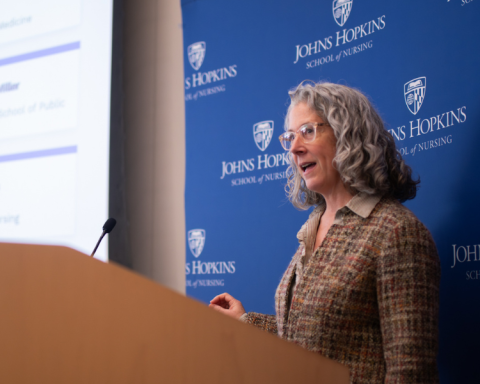
In a separate session, Paul Nagy, PhD, introduced the School of Medicine's RAISE Center for Responsible AI in Clinical Data Science, and Allen Kachalia, MD, MPH, presented on the Armstrong Institute for Patient Safety and Quality, which has secured more than $100 million in research funding over the past decade.


Workgroup breakouts
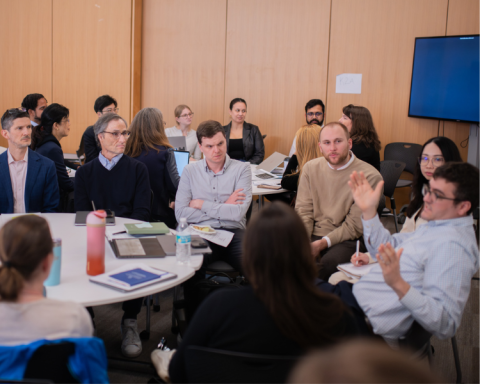
Five HBHI workgroups presented their goals and then broke into small-group discussions. Attendees chose two to visit across two rounds, a format designed to spark the kind of connections that drive new collaborations between retreats.

The groups spanned HBHI's research landscape: the Learning Health Systems Symposium, led by Jodi Segal, MD, MPH, and Risa Wolf, MD; Post-Acute Care Payment and Policy, led by Kathryn Linehan, MPH, and Kate Miller, PhD; Knowledge to Action, led by Kathy McDonald, PhD, MM; the Truveta User Community, led by Joe Levy, PhD, and Maggie Li, MA; and the Medicare Advantage Data Lab, led by Dan Polsky, PhD, and Frank Xu, PhD.




Innovation pitches
An afternoon session on innovation and commercialization, co-hosted with the Innovation Translation Council, featured three pitches aimed at advancing research into practice.
James Buchanan, an MD/MBA student and HBHI Graduate Academy fellow, presented Eligio, an AI tool designed to help frontline schedulers route patients to the right specialist on the first call. He pointed to one Hopkins department where 3,000 referrals were escalated to physician review in a single year, consuming 500 hours and $100,000 in lost value. Gordon Gao, PhD, MBA, presented PREP.AI, an agentic AI platform that prepares clinicians and patients before and after diabetes visits. Vadim Dukhanin, MD, MHS, closed with a pitch for a patient-facing AI app that turns safety reports into structured, multilingual data that health systems can act on in real time.


Anthony Leung, PhD, who moderated the session with Graduate Academy fellow Bonnie Koo, announced that an AI and Health Care Idea Tank will follow on May 8.
New pilots
The retreat closed with breakout sessions for eight new 2026 HBHI and Truveta pilot grantees, who presented their research plans and received feedback from the broader community. Attendees chose among four themed rooms, each featuring two pilot teams.
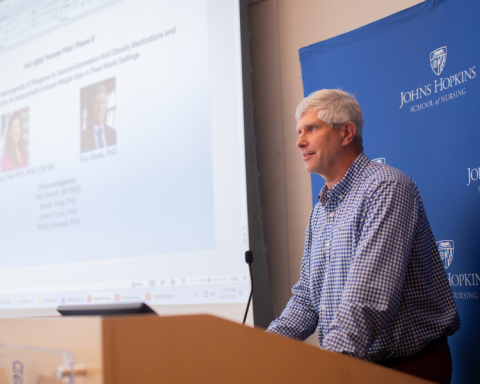

In the behavioral health room, Eric Slade, PhD, of the School of Nursing and Bloomberg School, presented a study on anti-obesity medications for antipsychotic-induced weight gain, and Johannes Thrul, PhD, MS, of the Bloomberg School, presented on the epidemiology of cannabis hyperemesis syndrome using multi-system EHR data. In cancer and cardiology, Elham Hatef, MD, MPH, of the School of Medicine, presented work on optimizing telehealth for cancer patients, and Caitlin Hicks, MD, MS, presented on using Truveta data to study carotid artery stenting outcomes. A third room focused on technology in care delivery, where Anjali Bhatla, MD, MBA, and Ravi Gupta, MD, of the School of Medicine, presented on remote patient monitoring in Medicare, and Derek J. Baughman, MD, presented on quantifying the return on investment of ambient AI scribes. In the clinical decision-making room, Marika Cusick, PhD, MS, of the Bloomberg School, presented on fairness in the kidney failure risk equation, and Miriam Quinlan, MD, MPH, MS, of the School of Medicine, presented on how clinician language choices during prognostication affect outcomes in severe brain injury.
Community members were asked to offer each team specific feedback: what they found most exciting about the work, who the presenters should connect with, and how they might amplify their findings with HBHI support.

