
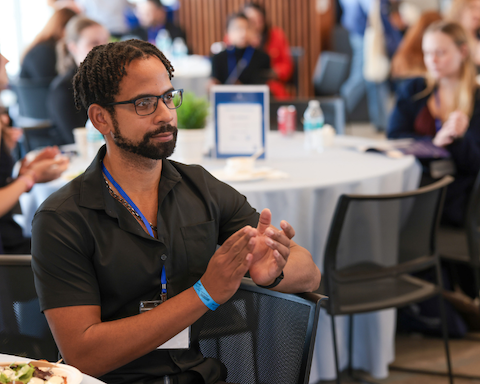
Artificial intelligence in clinical workflows. The shifting economics of healthcare payment. Precision oncology. Value-based care in practice. Global access to medicine. These topics shaped the 2026 Health Care Business Conference, hosted by Johns Hopkins Carey Business School and co-sponsored by the Hopkins Business of Health Initiative, March 5–6. The conference fostered lively debate among over 200 in-person and 150 remote attendees, sparking new collaborations and ideas through two days of panels, keynotes, workshops, and a student-led case competition, all under the theme "Disruption to Discovery: Innovation in the Business of Health."
Speakers represented the New England Journal of Medicine, Johns Hopkins Health Plans, Johns Hopkins Health System, Johns Hopkins Medicine, the CMS Innovation Center, University of Miami Sylvester Comprehensive Cancer Center, Mass General Brigham Cancer Institute, AstraZeneca, Guardant Health, and Kaiser Permanente.

Graduate Academy students from the Hopkins Business of Health Initiative attended the conference, engaging with panelists and practitioners. The event gave students rare access to health care executives, researchers, and industry leaders at the business-health intersection, broadening perspectives and providing insight into future career and research paths.



Leadership from across the Johns Hopkins health ecosystem
The conference showcased the breadth and impact of Johns Hopkins' health enterprise, highlighting how its expertise advances care delivery and policy. HBHI Director Dan Polsky, PhD, moderated a panel on policy turbulence and payment innovation. JP Holland, MBA, president and CEO of Johns Hopkins Health Plans, sat alongside him, offering a payer's perspective on the challenges—and progress—of coordinating care across a $3.5 billion health plan.


On another panel about scaling AI in health care, Carolyn Carpenter, president of the National Capital Region for Johns Hopkins Health System, and Brian Hasselfeld, MD, executive medical director for Digital Health and Innovations at Johns Hopkins Medicine, discussed successes and challenges moving AI from experimentation into daily operations.


In all, ten HBHI core faculty members participated as moderators and panelists, representing four Johns Hopkins divisions: the Carey Business School, the Bloomberg School of Public Health, the School of Medicine, and the Whiting School of Engineering.
Tinglong Dai, PhD, and Christopher Myers, PhD, led a debate on the boundary between artificial and human intelligence in clinical settings. Risa Wolf, MD, joined a panel on how clinicians and technology can improve patient outcomes. Gordon Gao, PhD, MBA, spoke on the organizational groundwork needed before adopting AI.


Ellesse-Roselee Akré, PhD, MA, contributed to discussions about health equity. Michael Darden, PhD, moderated a session on digital mental health with Gail Daumit, MD, MHS, and Ananya Joshi, PhD, who discussed expanding access to care and innovative care models.


Carey Business School students and staff organized the conference, sponsored by the Hopkins Business of Health Initiative, with Polsky and Darden as faculty advisors. Their collective efforts helped showcase innovation, deepen academic-industry relations, and inspire actionable ideas for the future of health care.
Read the full Carey Business School coverage